


I’ve spent years believing that if I just earned a little more, achieved a little more, I’d finally feel like enough. But here’s the uncomfortable truth: the more I tied my self-worth to my bank account, the more fragile my confidence became. It wasn’t just about the money—it was about what the money meant.
Every financial fluctuation felt like a referendum on my value as a person. And I’m not alone.
Research across 162 countries, with over 1.6 million participants, reveals a stark pattern: when people base their self-esteem on financial success, they don’t just chase wealth—they internalize it as their identity. The result? A life spent in a cycle of stress, comparison, and isolation, where no amount of money ever feels like “enough.” The emotional toll is severe, and the psychological costs are even higher.
Money can make you feel proud, but it won’t make you feel whole. And that’s the cruel irony of Financial Contingency of Self-Worth.
The Psychology of Financially Contingent Self-Worth
What Is Financial Contingency of Self-Worth?
Financial Contingency of Self-Worth (FCSW) is the psychological phenomenon where individuals tie their self-esteem directly to their financial success. It’s not just about wanting money—it’s about basing your entire sense of worth on how much you earn, save, or spend. Research shows that people with high FCSW don’t just value financial stability; they internalize it as a core part of their identity. When their financial status is threatened, their self-esteem crumbles, leading to a cascade of negative emotions and behaviors.
Studies confirm that FCSW is distinct from general materialism or financial goals. For example, in a national sample of 370 participants, researchers used confirmatory factor analysis to show that FCSW is a unique psychological construct, separate from other contingencies like appearance, academic success, or social approval. Participants completed scales measuring FCSW alongside other self-worth domains, revealing that those with high FCSW experienced more financial stress, anxiety, and diminished autonomy—even when controlling for actual income levels.
This suggests that the issue isn’t just about having money; it’s about what money means to you. If your self-worth is hitched to your bank account, every financial fluctuation becomes a personal crisis. 1
How Money-Driven Self-Worth Undermines Well-Being
Here’s the cruel irony: chasing money for self-worth doesn’t just fail to deliver happiness—it actively undermines well-being. Studies show that people with high FCSW report higher levels of financial stress, anxiety, and even physical symptoms like racing hearts or difficulty breathing. In one study, participants with high FCSW who faced a financial threat (like a hypothetical job loss) experienced a significant drop in autonomy—their sense of control over their lives plummeted.
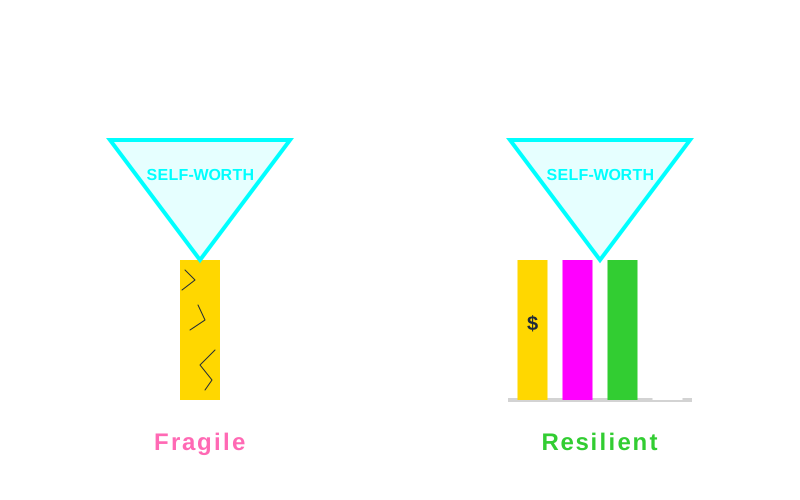
This wasn’t just about the money; it was about their identity being shaken. What’s fascinating is that these effects persist even after accounting for actual financial status.
Whether you’re wealthy or struggling, if your self-worth is contingent on money, you’re more likely to feel trapped in a cycle of stress and comparison. The research suggests that FCSW isn’t just a byproduct of financial hardship; it’s a mindset that creates hardship, turning every financial decision into a high-stakes test of personal value.
The Financial Comparison Trap: Why You’ll Never Feel Rich Enough
People with high FCSW don’t just stress about money—they obsess over it in relation to others. Studies show they engage in more financial social comparisons, constantly measuring their worth against peers, colleagues, or even strangers. This isn’t just harmless benchmarking; it’s a psychological trap. Every time they see someone with a nicer car, a bigger house, or a fancier vacation, it’s not just envy—they feel it as a direct threat to their self-esteem.
This comparison habit fuels a cycle of dissatisfaction. Research found that individuals with high FCSW report more daily financial “hassles”—those small but relentless stressors like unexpected bills, budgeting failures, or the gnawing fear of not having enough. These hassles aren’t just annoyances; they’re existential threats. Because their self-worth is tied to money, every financial setback feels like a personal failure.
The result? A life spent chasing an ever-moving target, where no amount of money ever feels like “enough.” The data is clear: FCSW turns money into a double-edged sword.
It promises security and status but delivers anxiety and isolation. The more you stake your identity on financial success, the more vulnerable you become to its whims—and the harder it is to ever feel truly secure.
How Society Conditions Us to Link Money and Self-Esteem
Does More Money Boost Self-Esteem? A New Study
Let’s talk about the chicken-and-egg problem of money and self-worth. Does earning more make you feel better about yourself, or does feeling good about yourself help you earn more? A 2023 longitudinal study with over 4,000 participants finally put this to the test—and the results are stark. Income increases predict rises in self-esteem far more reliably than self-esteem predicts future income.
This isn’t just correlation; it’s a directional relationship. The study tracked participants over nearly a decade, measuring emotions, income, and sense of control at multiple points. What emerged was a clear pattern: when people’s incomes went up, their self-regard emotions—pride, confidence, contentment—followed suit. But the reverse?
Barely a blip. Self-esteem didn’t meaningfully drive future earnings. This flips the script on the “just believe in yourself” narrative. It’s not that confidence doesn’t matter, but the data suggests that in the real world, money talks first, and self-worth listens.
What’s fascinating is how this plays out across different emotional domains. The study found that income’s impact on self-regard emotions (like pride or shame) was far stronger than its effect on other-regard emotions (like gratitude or anger). In other words, money makes you feel better about yourself—not necessarily more connected to others. This aligns with the broader research showing that while higher income predicts feeling proud or confident, it doesn’t reliably make people feel more grateful or caring.
The emotional benefits of money, it seems, are largely self-directed. It’s a lonely kind of validation, one that bolsters your internal narrative but doesn’t necessarily warm your relationships. 2 The study also addressed a critical methodological gap in past research. Earlier studies often measured emotions retrospectively, which can be skewed by memory biases, or compared different nations, which introduces cultural noise.
This study, however, measured emotions felt in the past day and the past month, capturing both immediate reactions and more stable emotional trends. The consistency of the findings across these timeframes suggests that the link between income and self-regard isn’t just a fleeting mood boost—it’s a durable shift in how people perceive themselves.
And here’s the kicker: this effect held even after controlling for baseline emotions. That means income doesn’t just amplify existing emotional states; it actively reshapes them over time.
How Income Shapes Our Self-Worth: A Global Pattern
If you think this is just a Western phenomenon, think again. The pattern holds across 162 countries, from the wealthiest nations to those with far lower GDP. In a massive Gallup study spanning over a decade, researchers found that higher income consistently predicted lower negative self-regard emotions (like shame and fear) and higher positive self-regard emotions (like pride and confidence). The effect sizes varied, but the direction was nearly universal.
Only one country—Namibia—showed a nonsignificant positive relationship, and even then, it was an outlier in a sea of consistency. This isn’t about culture or local values; it’s about a fundamental psychological mechanism tied to financial security. The study also revealed something profound about the strength of these relationships. The association between income and negative self-regard emotions was about three times larger than the association between income and negative other-regard emotions.
In plain terms: money protects you from feeling bad about yourself far more than it makes you feel warm and fuzzy toward others. This aligns with the idea that financial stability acts as a buffer against shame and fear—emotions that are deeply tied to personal inadequacy. When you’re struggling financially, the world feels like a series of threats and failures.
When you’re stable, those threats recede, and your self-perception shifts from vulnerability to capability. But here’s where it gets complicated.
The study also tested whether lower income might foster interdependence— the idea that financial struggle could make people more reliant on and connected to their communities. The data? Mixed at best.
While some research suggests that lower socioeconomic status can cultivate interdependent traits, this study found little evidence that lower income reliably predicts positive other-regard emotions like gratitude or communal feelings. Instead, financial hardship often bred hopelessness and resignation.
It’s a grim reminder that poverty doesn’t just limit your bank account; it can erode your sense of agency and connection. The emotional landscape of financial struggle isn’t one of shared resilience—it’s often one of isolation and despair. 2
Why Money Boosts Self-Esteem Through Control
So why does money have this outsized effect on how we feel about ourselves? The answer lies in sense of control. Research shows that income’s impact on self-regard emotions is mediated by how much control people feel they have over their lives. Higher income doesn’t just buy comfort; it buys autonomy.
When you have more money, you’re less at the mercy of unpredictable financial shocks—a broken-down car, a medical bill, a sudden job loss. That stability translates into a deeper sense of agency, which in turn shapes your emotional landscape. Pride, confidence, and contentment flourish when you believe you’re the author of your own story. Shame and fear thrive when you feel like a victim of circumstance.
A longitudinal study using a cross-panel design found that income at an earlier time point predicted higher sense of control a decade later, which then predicted greater positive self-regard emotions and lower negative self-regard emotions. This isn’t just about feeling good in the moment; it’s about a lasting shift in how you perceive your place in the world.
The mediation analysis revealed that sense of control accounted for a significant portion of the relationship between income and self-regard emotions. In other words, money’s emotional benefits aren’t just about the numbers in your bank account—they’re about what those numbers represent: freedom, choice, and the ability to navigate life’s challenges without constant fear. This mechanism also explains why the emotional benefits of income are so strongly tied to self-regard rather than other-regard.
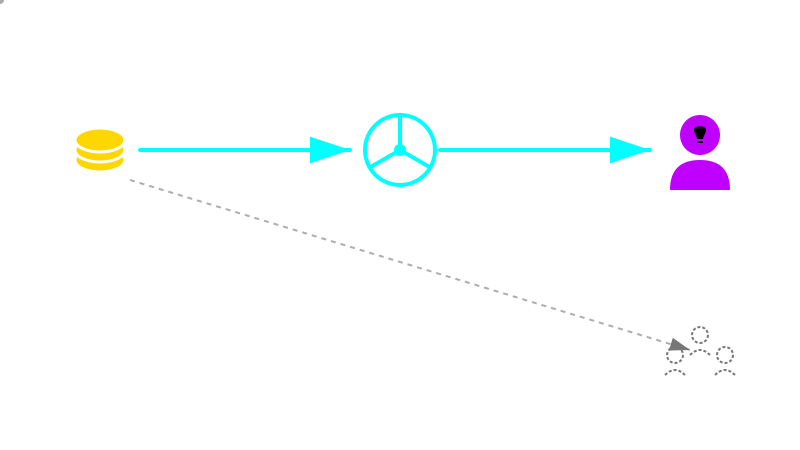
Sense of control is inherently personal. It’s about your ability to shape your own outcomes, not necessarily your ability to connect with or support others. When you feel in control, you’re more likely to experience emotions like pride and confidence—emotions that reinforce your self-worth. But that sense of control doesn’t automatically translate into feelings of gratitude or communal warmth.
Those emotions depend on different psychological processes, ones that money alone can’t easily buy. What’s striking is how this plays out in the long term. The study found that income predicted self-regard emotions 10 years later, even after controlling for baseline emotions. This suggests that the psychological benefits of financial stability aren’t just temporary mood boosts—they’re durable changes in how you see yourself.
But here’s the catch: this also means that financial instability can have lasting emotional scars. If your sense of control is repeatedly undermined by financial insecurity, the negative self-regard emotions—shame, fear, helplessness—can become entrenched. It’s a cycle that’s hard to break, one that reinforces the idea that your worth is tied to your wallet.
The Hidden Costs of Conflating Income with Identity
How Financial Self-Worth Creates Loneliness
There’s a quiet tragedy in the way money can isolate us. When your self-worth is hitched to your bank account, relationships often become collateral damage. Research shows that people with high Financial CSW don’t just feel lonely—they actively disengage from the very connections that could buffer them against stress. They spend less time with family and friends, not because they’re busy, but because financial preoccupations create a psychological barrier.
Every social interaction becomes a potential threat: a reminder of what they don’t have, or a performance to prove they do. This disengagement isn’t just about time; it’s about emotional withdrawal. When financial stress looms, people with high FCSW are more likely to cope through avoidance—denial, distraction, or outright withdrawal from relationships.
It’s a self-protective instinct, but one that backfires. The more you isolate, the more your self-worth becomes dependent on money, and the more fragile your emotional resilience grows.
The irony? The very thing you’re chasing—financial security—becomes harder to achieve when you’re cut off from the social support that could help you navigate challenges.
How FCSW Fuels Relationship Conflict
Money is the leading cause of conflict in relationships, and for those with high FCSW, it’s not just a practical issue—it’s an existential one. When your self-esteem is tied to financial success, every budget discussion, every unexpected expense, becomes a referendum on your worth. Partners of people with high FCSW often report feeling like they’re walking on eggshells, where financial decisions are laden with emotional landmines. The data is clear: couples where one or both partners have high FCSW experience more frequent and intense financial conflicts, which in turn predict lower relationship satisfaction.
It’s not just about the money; it’s about what the money represents. For someone with high FCSW, a partner’s spending habits aren’t just a practical concern—they’re a direct threat to their self-image.
The result? A cycle of blame, resentment, and emotional withdrawal that erodes trust over time.
The High Cost of Tying Self-Worth to Money
The psychological toll of FCSW is staggering. When your self-worth is contingent on financial success, you’re not just chasing money—you’re chasing an illusion of stability that never arrives. Studies show that people with high FCSW engage in relentless social comparison, measuring their worth against others in a game that’s rigged to make them feel deficient. Every promotion, every luxury purchase, every social media post becomes a benchmark for their own inadequacy.
This comparison trap fuels a cycle of financial stress that’s uniquely corrosive. Unlike general financial worry, FCSW-driven stress is tied to identity. It’s not just “I’m worried about my bills”—it’s “I’m worried about what my bills say about me.” The emotional fallout is severe: higher rates of anxiety, depression, and even physical health problems.
And here’s the kicker: the emotional benefits of money—pride, confidence, contentment—are fleeting when they’re contingent on external validation. Money can make you feel proud, but it won’t make you feel grateful or connected. The more you stake your self-worth on financial success, the more you sacrifice the very things that make life meaningful.
Capitalism’s Identity Crisis: When Productivity Becomes Self-Worth
How Capitalism Turns Identity Into a Performance of Productivity
Capitalism doesn’t just shape economies—it reshapes identities. Under this system, worth isn’t intrinsic; it’s transactional. You’re not valued for who you are, but for what you produce. This isn’t just a critique from fringe theorists; it’s a psychological reality backed by research.
Studies show that when self-worth is tied to financial success, people don’t just chase money—they internalize productivity as the core of their identity. Consider the language of modern work culture: “hustle,” “grind,” “crush it.” These aren’t just slogans; they’re mantras that equate human value with output. The research on Financial CSW reveals how this plays out in practice.
Participants in studies who based their self-esteem on financial success didn’t just report higher stress—they exhibited a fundamental shift in how they perceived themselves. Their autonomy plummeted when faced with financial threats, not because they lacked resources, but because their identity was under siege. When your sense of self is contingent on productivity, every setback isn’t just a challenge—it’s an existential threat. This framework turns life into a performance review.
You’re not just working to live; you’re living to prove your worth through work. The psychological toll is severe. People with high FCSW don’t just feel pressure—they feel controlled by it.
Their coping strategies reflect this: disengagement, avoidance, denial. It’s not just about solving problems; it’s about protecting a fragile self-image that’s hitched to external validation.
The irony? The more you perform, the less authentic you become.
The High Cost of a Transactional Identity
Under capitalism, identity becomes a balance sheet. You’re not a person with complexities and contradictions—you’re a set of metrics. Titles, salaries, promotions: these aren’t just achievements; they’re the currency of self-worth. The research on Financial CSW shows how this plays out in real life.
Participants who tied their self-esteem to financial success didn’t just care about money—they cared about what money signaled. A high salary wasn’t just security; it was proof of value. A low one wasn’t just a challenge; it was a personal failure. This transactional identity isn’t just about money—it’s about conformity.
The studies reveal that people with high FCSW are more likely to engage in social comparison, constantly measuring themselves against others. But it’s not just envy; it’s a desperate attempt to validate their worth through external benchmarks. The problem? These benchmarks are moving targets.
There’s always someone with a bigger title, a higher salary, a more impressive resume. The result is a life spent chasing validation that never arrives. The psychological cost is staggering.
When your identity is transactional, authenticity becomes a liability. You’re not just adapting to capitalist values—you’re repressing parts of yourself that don’t fit the mold.
The research shows that people with high FCSW report lower autonomy, not because they lack freedom, but because they’ve internalized a framework that equates self-worth with performance. The more you conform, the less you recognize the parts of yourself that can’t be measured.
How Financial CSW Represses Your Authentic Self
The most insidious effect of this framework is the repression of the authentic self. When worth is tied to productivity, traits like kindness, creativity, or integrity become secondary. They’re not just undervalued—they’re actively suppressed. The research on Financial CSW shows how this plays out.
Participants who based their self-esteem on financial success didn’t just prioritize money—they deprioritized other aspects of their identity. Their coping strategies reflected this: disengagement from problems, avoidance of vulnerability, denial of struggle. This isn’t just about work—it’s about identity. When your self-worth is contingent on external validation, you’re not just chasing success; you’re fleeing from the parts of yourself that don’t fit the capitalist mold.
The studies reveal that people with high FCSW are more likely to experience stress and anxiety, not because they’re failing, but because they’re constantly performing. The result is a life spent in a state of low-grade panic, where every decision is a calculation of worth. The tragedy?
The more you conform, the less you recognize the cost. The research shows that people with high FCSW don’t just feel controlled—they become controlled.
Their autonomy erodes, not because of external forces, but because they’ve internalized a framework that equates self-worth with productivity. The result is a life spent chasing validation that can never be fully attained—a cycle of performance, stress, and repression that leaves the authentic self buried under metrics. 1
Breaking Free: Building Self-Worth Beyond Your Bank Account
How Self-Affirmation Protects Against Financial Stress
Here’s the paradox: the more you stake your self-worth on financial success, the more fragile your self-esteem becomes. But what if there was a way to short-circuit that fragility? Study 3 offers a compelling answer: self-affirmation. When participants with high Financial CSW were asked to reflect on their personal strengths before facing a financial threat, their sense of autonomy took less of a hit compared to those who didn’t affirm themselves.
It’s not just positive thinking—it’s psychological armor. The mechanism is fascinating. Self-affirmation theory suggests that when you remind yourself of your core values—traits, relationships, or accomplishments unrelated to money—you create a buffer against threats to your self-worth. For someone with high FCSW, a financial setback isn’t just a practical problem; it’s an identity crisis.
But if you’ve just spent five minutes writing about why you’re a good friend, a creative thinker, or a resilient person, that setback feels less like a verdict on your entire being. The study found that this effect wasn’t just about distraction—it actually reduced the defensive reactions that normally kick in when financial security is threatened. Participants who self-affirmed were less likely to disengage or avoid their financial problems, suggesting they felt more capable of facing challenges without their self-esteem crumbling.
The implications are profound. Self-affirmation isn’t about denying financial realities—it’s about decoupling your worth from them.
It’s a way to say, “Yes, money matters, but it doesn’t define me.” And the beauty is in its simplicity: a few minutes of reflection can rewire how you respond to financial stress. This isn’t just academic theory—it’s a practical tool.
The next time you feel your self-esteem wobble with a market dip or an unexpected bill, try listing three things you value about yourself that have nothing to do with money. It’s not a magic fix, but it’s a start. 2
Redefine Success: Value Growth Over Income
We’ve been sold a lie: that success is a number in a bank account, a title on a business card, or a zip code. But the research is clear—this definition of success is a psychological trap. When your self-worth is contingent on external validation, you’re not just chasing money; you’re chasing an illusion of control that never materializes. The alternative?
Redefine success on your own terms. Studies show that people who base their self-worth on internal measures—personal growth, meaningful relationships, contribution to others—experience more stable well-being. They’re not immune to financial stress, but they’re less likely to let it define them. This shift isn’t about rejecting ambition; it’s about recalibrating what ambition means.
Instead of asking, “How much am I worth?” ask, “What am I contributing?” Instead of measuring yourself against others’ salaries, measure yourself against your own values. The research on Financial CSW reveals that this recalibration isn’t just philosophical—it’s psychological survival. When your self-worth is diversified, financial setbacks hurt less because they don’t threaten your entire identity. This redefinition requires courage.
It means resisting the cultural narrative that equates net worth with human worth. But the payoff is freedom—the freedom to define success as something more than a paycheck. It’s the freedom to wake up and feel valuable not because of what you’ve earned, but because of who you are and how you’ve grown.
Why Diversifying Your Self-Worth Boosts Resilience
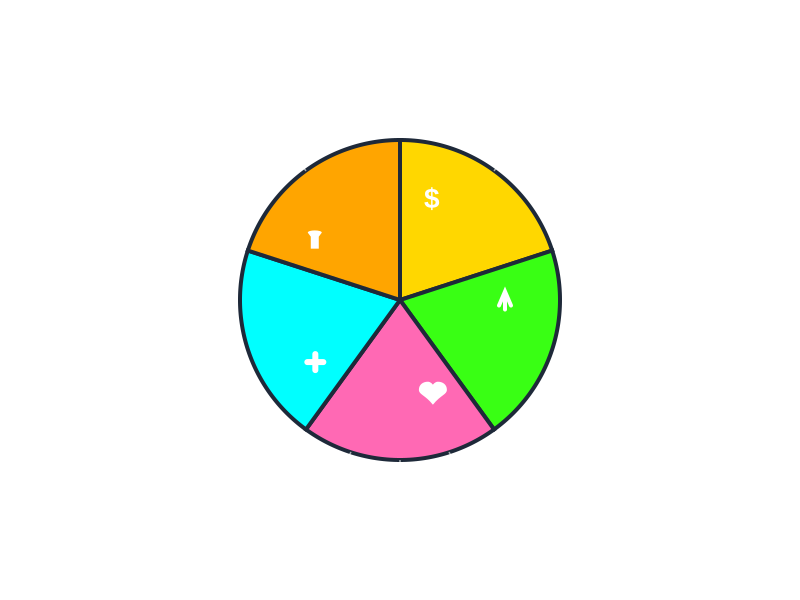
Think of your self-worth like an investment portfolio. If you put all your money into one stock—say, your salary—you’re exposed to massive risk. A single market crash (or job loss) can wipe you out. But if you diversify—spreading your investments across relationships, hobbies, personal growth, and community—you create resilience.
The same principle applies to self-esteem. Research shows that people with high Financial CSW are more vulnerable to stress because their self-worth is undiversified. When money is your sole source of validation, every financial fluctuation becomes a personal crisis. But when you cultivate multiple domains of self-worth, setbacks in one area don’t destabilize your entire identity.
This isn’t just metaphor—it’s psychology. Studies confirm that diversifying your contingencies of self-worth leads to greater emotional stability and lower anxiety.
The practical takeaway? Audit your self-worth portfolio. Where are you over-invested?
Where are you under-invested? If your identity is hitched to your bank account, it’s time to diversify. Cultivate a hobby that has nothing to do with productivity.
Nurture relationships that aren’t transactional. Engage in personal growth that isn’t tied to career advancement. The goal isn’t to abandon financial goals—it’s to ensure they don’t hold your entire self-esteem hostage.
Conclusion
We’ve been conditioned to believe that money is the ultimate scorecard of human value—a belief so deeply ingrained that it feels like common sense. But the research tells a different story: when we tie our self-worth to our bank accounts, we don’t just risk our financial stability; we gamble with our very sense of self. The more we internalize money as identity, the more we surrender our autonomy to a system that will never let us feel secure enough. It’s a paradox: the thing we chase for validation ends up making us feel more vulnerable, more isolated, and more afraid.
So what’s the alternative? It’s not about rejecting money or ambition—it’s about refusing to let them define us. The studies show that self-affirmation, diversified self-worth, and a redefinition of success can act as psychological buffers against the volatility of financial identity.
When we cultivate pride in who we are—not just what we earn—we build resilience that no market crash can erase. (And let’s be honest: if your self-esteem is hitched to your portfolio, you’re always one bad quarter away from an existential crisis.)
The question isn’t whether money matters—it’s whether it should matter this much. What if, instead of asking, “How much am I worth?” we asked, “What am I contributing?” or “How am I growing?” The shift isn’t just semantic; it’s a reclaiming of agency. Money can buy comfort, but it can’t buy the quiet confidence of knowing your worth isn’t for sale.
Footnotes
-
Park, Lora E., Deborah E. Ward, and Kristin Naragon-Gainey. “It’s all about the money (for some): Consequences of financially contingent self-worth.” Personality and Social Psychology Bulletin 43.5 (2017): 601-622. ↩ ↩2
-
Tong, Eddie MW, et al. “Income robustly predicts self-regard emotions.” Emotion 22.7 (2022): 1670. ↩ ↩2 ↩3


