


Emperor Marcus Aurelius, the most powerful man in the Mediterranean, found himself besieged. His reign was not marked by tranquility but by the relentless Antonine Plague, which ravaged his empire, coupled with devastating wars and massive earthquakes. He could not halt the death toll or reverse the geologic tremors.
Yet, facing this tidal wave of catastrophe, Aurelius did not despair or resort to panic. Instead, he methodically sold off imperial jewels and treasury assets to fund relief efforts, demonstrating that even the highest office could be governed by rational duty.
His power lay not in stopping the suffering, but in choosing how he responded to the uncontrollable external facts of plague and ruin. The true measure of a philosophy is how it behaves under duress; these historical crucibles reveal that Stoicism is not a shield against life’s severity, but a precise toolkit for navigating it with unflinching reason.
The ‘Stiff Upper Lip’ Myth: What Stoicism Isn’t
Stoicism: Regulation, Not Emotional Suppression
The most tenacious misconception about Stoicism is the image of the cold, unfeeling “statue” who suppresses every flicker of emotion. This couldn’t be further from the truth, and the ancient masters were emphatically clear on this point. Epictetus, one of the great Stoic teachers, famously cautioned his students, “I don’t want you to become unfeeling statues. You’re human beings, not pieces of marble.”
The core of Stoicism isn’t about eliminating feeling; it’s about acknowledging that we are sentient beings who will react to the world, but we must choose how we respond to those initial reactions. What philosopher Massimo Pigliucci highlights is that the Stoic method focuses entirely on handling and modulating your emotions, which requires significant self-control and presence of mind. Consider a high-stress moment: It might be perfectly fine to retreat to a private place and scream out your frustration—if it makes you feel better, go for it!
However, good Stoic practice dictates that you shouldn’t scream in the middle of a chaotic situation, especially if doing so would frighten your children or escalate a conflict. This vital distinction separates unhealthy emotional repression (bottling feelings until they explode) from healthy, contextual regulation (directing feelings constructively based on what you can control) 1.
How Philosophy Terms Get Distorted Today
It’s often comforting to realize that the linguistic degeneration of Stoicism is not unique; it’s a process that has distorted many major Greco-Roman philosophical schools over the centuries. When we look at why the word “Stoic” has come to mean joyless, we can trace a similar trajectory with terms like Skepticism, Cynicism, and especially Epicureanism. These words still exist in common parlance, but their modern definitions bear only a faint, distorted resemblance to their original meanings. Take, for example, the modern idea of an “Epicurean.”
Today, if you identify as one, people instantly conjure images of lavish excess, perhaps even “sex, drugs, and rock and roll,” but this entirely misses the original point. Epicurus taught that the highest good was ataraxia (freedom from mental disturbance) and aponia (absence of physical pain).
They actually pursued very mild pleasures, valuing simple meals, deep friendships, and avoiding life choices that would lead to future suffering. If a philosophy dedicated to pain avoidance and tranquility can be warped into extreme hedonism, it becomes clear why Stoicism, a philosophy rooted in resilience and restraint, was mistakenly transformed into an advocacy for the stiff upper lip.
Debunking ‘Broicism’: Virtue Means Excellence
The modern distortion of Stoicism has given rise to highly specific misinterpretations, particularly among those who attempt to appropriate it as a purely masculine discipline—a phenomenon Pigliucci aptly dubs “Broicism.” These aspiring Stoics often make a fundamental mistake rooted in etymology, claiming Stoicism is intrinsically male because the Latin word for “virtue,” virtus, stems from Vir, which means “man.” This conclusion, however, is deeply misleading and requires only a single additional step to debunk.
The Latin Vir is merely a translation of the Greek term Arete, which is the foundational Stoic concept and means “excellence” or “doing the best you can.” Crucially, Arete is entirely gender-neutral.
Therefore, any attempt to confine Stoicism to a specific gender identity or approach is simply a distortion that fundamentally misunderstands its universal goal. True Stoicism seeks excellence in character, demanding intellectual rigor and emotional management from anyone, regardless of their background, as embodied by both the Emperor Marcus Aurelius and the formerly enslaved teacher Epictetus.
The Fundamental Rule: Mastering the Dichotomy of Control
The Dichotomy of Control: What You Can Change
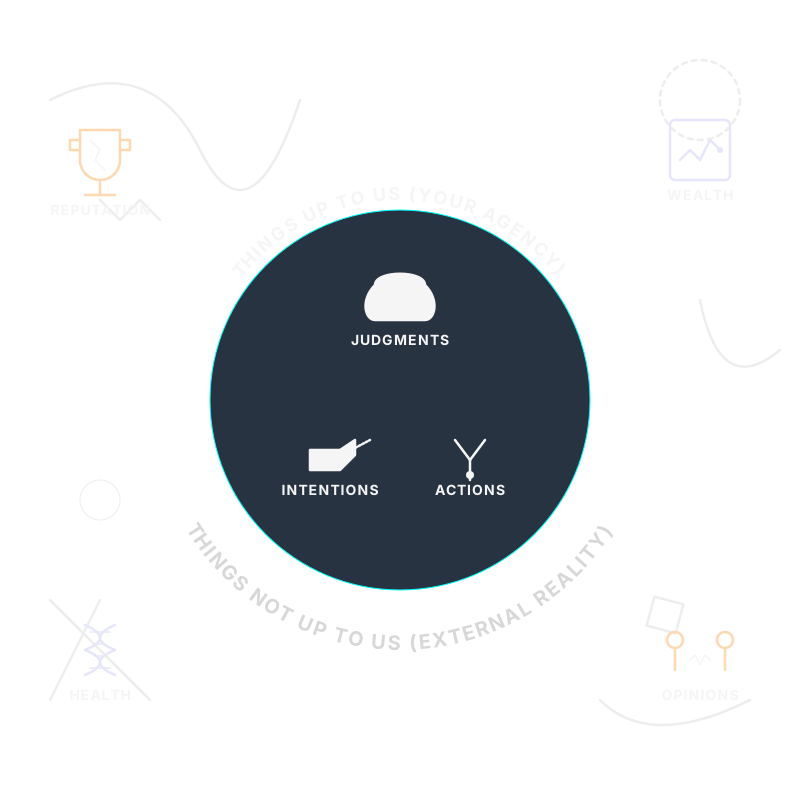
If emotional regulation is the main task of Stoicism, then the Dichotomy of Control—or, as Epictetus powerfully termed it, the fundamental rule—is the toolkit we use to achieve it. This principle demands a ruthless, clear-eyed distinction: some things are entirely up to us, and others are definitively not. What falls into the controllable category? Surprisingly little:
- our judgments
- our immediate assessment of a situation
- our resulting actions, or as philosopher Pigliucci summarizes, simply, Your response to the world.
Everything else, from health to wealth, reputation, relationships, and the outcome of any effort, is categorized as external and therefore not fully up to us. This is counterintuitive; we feel like we control our health, yet genetics, accidents, and environment play huge roles. The Stoics argue that while we control the effort we put into exercising and eating well, we do not control the result—the long-term physical outcome.
Acknowledging this lack of ultimate control is liberating. You have two choices when faced with an uncontrollable external event: either accept it with equanimity or throw a tantrum. Since only one of those options is efficacious for a mature adult, the answer becomes clear, mirroring the famous Serenity Prayer used even today in modern twelve-step organizations 1.
Stop Eating the Bitter Cucumber
Once we understand the dichotomy, the next crucial step is to avoid the psychological pitfall of self-inflicted suffering. Marcus Aurelius offered a brilliant analogy that strikes at the heart of unnecessary anguish: “You don’t like the cucumber because it’s bitter. Well, don’t eat it. Why do you have to go on and complain about the fact that there are bitter cucumbers in the world?”
The point isn’t about the cucumber itself (the external problem); the problem is the added layer of mental complaint. Complaining about the unchangeable doesn’t make it better; it merely fuels dissatisfaction and allows you to wallow in self-pity, adding internal pain to the existing external injury.
This is vividly illustrated by the common experience of post-event obsession, like agonizing over test answers after the exam is over. The moment the test ends, the outcome is fixed—ruminating on what should have been done is the mental equivalent of forcing yourself to eat that bitter cucumber.
Reacting Rationally: Wallet Stolen in Rome
This philosophy isn’t just theoretical; it delivers profound practical results during moments of crisis. Massimo Pigliucci shared a powerful personal anecdote of having his wallet stolen on the subway in Rome. In a scenario designed for panic and anger, the Stoic realization kicked in immediately: the wallet was gone. That outcome was immutable.
Getting angry at the pickpocket, the city, or himself for being “stupid” would have been pointless self-harm. Instead of throwing a tantrum, Pigliucci shifted agency back to the controllable sphere: the response. The focus became rational action: immediately dealing with the practical necessity of canceling cards and securing identification.
As Seneca, who wrote extensively On Anger, taught, the goal is always to create a mental detachment from the acute situation—count to twenty, take a breath, or physically remove yourself—anything to keep your presence of mind and act rationally. Panic never helps; only purposeful action can salvage a bad situation.
Empowerment Through Agency and Anxiety Reduction
The most significant gift of the dichotomy of control is empowerment. By meticulously identifying what is external and accepting it with equanimity, you aren’t cultivating apathy; you are refining your focus onto the space where your agency truly operates. The enormity of a problem is never an excuse for inaction, because there is always something within your control—your decision to engage, your effort, and your intention. You care deeply about succeeding, but true “caring” manifests as doing your absolute best effort, and then letting go of the outcome, knowing that success is never guaranteed.
This shift is remarkably effective at reducing anxiety. If you fail a test or lose a job, that event is an external outcome. If you fail a test or lose a job, that event is an external outcome.
What remains under your control is the ability to learn from the mistake, regroup, and decide your next course. This perspective transforms overwhelming external forces into manageable internal choices, ensuring you always retain command over your inner life.
Living ‘According to Nature’: The Four Virtues and Social Duty
The Four Stoic Virtues: Your Moral Compass
Beyond the fundamental rule of control, Stoicism provides a clear moral compass through its emphasis on living according to nature—meaning, according to human nature. Since we are inherently rational and highly social animals, the goal of a well-lived life is to be rational and pro-social. This life is governed by the Four Cardinal Virtues:
- Wisdom
- Justice
- Courage
- Temperance (or self-control)
These virtues are the only true good, representing an “excellence” (Arete) of character that should be the focus of all our efforts.
In an age dominated by doom scrolling and constant negative input, focusing on these virtues is essential for maintaining constructive models of behavior. We aren’t meant to discount real-world problems, but rather to use the virtues as a filter for how we address them.
When you consciously cultivate courage, you choose to act in spite of fear; when you apply justice, you ensure your social dealings are fair; and wisdom enables you to discern what is actually good. By actively observing and emulating positive character traits in others, we build practical models for constructive behavior that counteract feelings of despair, grounding us in what truly matters: our character.
Cosmopolitanism: Your Duty to Humanity
The social nature of humanity leads directly to one of the most expansive Stoic concepts: Cosmopolitanism. This idea dictates that we should endeavor to view everyone on the planet—regardless of proximity, nationality, or personal acquaintance—as our fellow relatives and community members. This duty arises simply because we all share the basic capacity for reason and the propensity to live socially.
Reason, the Stoics argued, reveals the absurdity of treating people differently based on arbitrary external factors. Whether you know someone personally or not is merely an accident of personal history.
True reason commands us to recognize our inherent kinship with all rational beings. This concept elevates our responsibility far beyond just our immediate circle, embedding a powerful social duty into the very structure of Stoic ethics.
Stoicism: Action Over Being a Doormat
It is vital to stress that Stoicism is not about turning into a doormat. It’s not about passively “taking it” when others behave badly. Marcus Aurelius warned us to expect inconsiderate people because, well, that’s just a fact of life. The Stoic response isn’t resignation, but *a reasoned choice about action.
When faced with someone whose behavior you disapprove of, Marcus suggested two possible responses: either you teach them, explaining why their behavior is suboptimal, or, failing that, you bear with them. The choice depends entirely on whether correcting the behavior is within your power and conducive to a better outcome.
If you cannot correct them, the Stoic attitude is to look at their negative behavior not as a moral failing requiring blame, but as a defective faculty of judgment. This charity transforms anger into practical focus: What can I do here and now to ameliorate the situation, rather than wallowing in useless blame?
Charitable Judgment: Handling Difficult People Stoically
This charitable judgment is perfectly demonstrated by a listener’s anecdote involving a highly aggressive business partner whose actions threatened to damage a large group of colleagues. While most people reacted with immediate anger, the listener, John, responded with sadness, seeing the aggressive person not as “evil,” but as a misguided human being, perhaps even as a child who had gone astray. Massimo Pigliucci confirmed that this humane reaction is profoundly Stoic.
The Stoics fundamentally reject moral blame because simply labeling someone as “bad” or “evil” doesn’t solve anything; it only dismisses and potentially dehumanizes them. Instead, by focusing on the underlying reason for the person’s defective judgment—as Epictetus might put it—you keep your own emotional state intact. This charitable, rational outlook prevents you from adding anger to the situation, allowing you to focus purely on the controllable goal: leading the group to the best possible result despite the external challenge.
Your Stoic Toolkit: Three Practical Exercises for Daily Life
Your Daily Review: Epictetus’s Three Questions
To transition from philosophical understanding to practical wisdom, Stoicism requires daily practice, much like Emperor Marcus Aurelius used his Meditations as a personal journal. The most crucial daily exercise is the Evening Meditation, described by Seneca and Epictetus as a brief, intentional self-review before sleep. This practice requires just five or ten minutes in a quiet corner to reflect on the day’s salient events and how we handled them. Epictetus provided a structured approach through three specific questions, which have strong empirical backing from modern psychology:
- “What did I do wrong?
- What did I do right?
- And what could I do better the next time?”
This isn’t merely about introspection; it’s a structured self-analysis focused on growth.
It forces you to evaluate your actions against the three Stoic disciplines:
- the Discipline of Desire (assessing your values)
- the Discipline of Action (evaluating how you behaved toward others)
- the Discipline of Assent (judging the truth of your impressions)
By honestly critiquing your agency and intentions, you ensure continuous moral improvement.
Premeditatio Malorum: Rehearsing for Hardship
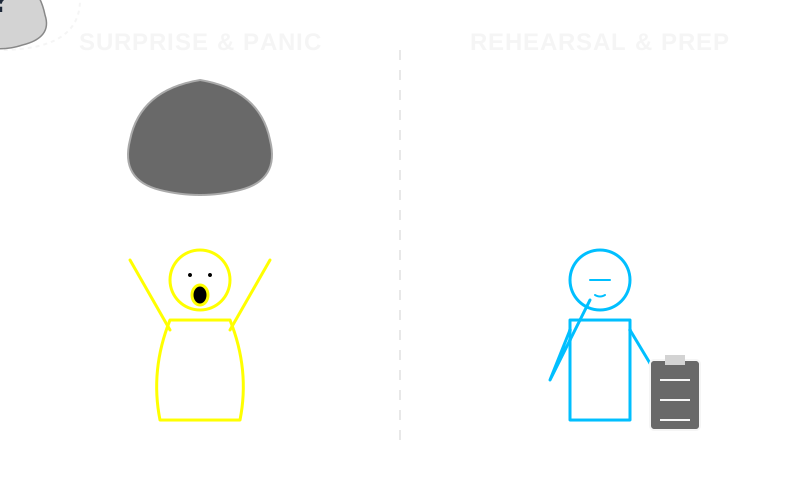
Another profoundly practical technique is the Premeditatio Malorum, or the “premeditation of evils,” which involves mentally rehearsing the worst-case scenarios. This isn’t a pessimistic exercise, but a form of psychological conditioning designed to inoculate you against shock and panic when adversity inevitably strikes. Seneca repeatedly advised this practice, noting that much of our anxiety stems from worrying about things that won’t happen.
By analytically detaching yourself and writing to yourself in the second person, as Massimo Pigliucci did when facing a potential health crisis, you force yourself to ask: “If this negative outcome happens, what are you going to do about it?” This rehearsal brings the external threat within the manageable sphere of your control.
You realize that even if you fail horribly or face a devastating diagnosis, the core principles of action still apply. This preparation removes the emotional element of surprise, leaving only the practical problem to be solved.
The View From Above: Gaining Cosmic Perspective
When our daily problems feel overwhelming, the Stoics prescribed the “view from above.” This exercise involves stepping back to contemplate our issues from a cosmic or broad temporal perspective. The goal is to gain humility and perspective, reminding yourself that your individual scale is not the only meaningful measure of existence.
While your problems are important to you, contemplating the vastness of the universe helps you relax the grip of immediate stress. This meditation works by temporarily zooming out, perhaps by watching videos that illustrate Earth’s place in the cosmos (like Carl Sagan’s “Pale Blue Dot”), to realize how miniscule our momentary frustrations are in the grand scheme.
The point is not to conclude that your problems are unimportant, but to realize that disproportionate anxiety is unwarranted. After achieving this perspective, you zoom back in, armed with renewed equanimity, ready to engage your agency and address the situation with clear, rational intent.
Stoicism Under Pressure: Lessons from Real-World Crises
Marcus Aurelius: Stoicism in Crisis
The true utility of Stoicism is revealed not in peacetime, but when the world is collapsing around us. No figure illustrates this better than Marcus Aurelius, the philosopher-king, whose reign was defined by relentless crises. He faced not just external wars, but the devastating Antonine Plague, which killed an estimated five million people, along with major natural disasters like the flood of the Tiber and a catastrophic earthquake. Marcus, a man literally determined to use philosophy as a framework for political and personal decisions, consistently applied the Dichotomy of Control to these impossible situations .
He could not control the virus or the earthquakes, but he could control his response. For instance, facing depleted imperial resources during the plague, he recognized that his duty was to act justly.
His solution was radical: he sold off vast amounts of the imperial treasury and his personal jewels to fund the relief effort. This response perfectly demonstrates Stoic leadership: accepting the uncontrollable reality while using wisdom and justice (two of the Cardinal Virtues) to make the most ethical, rational decision possible for the common good.
Facing Death: Stoicism in the ER
The moment of personal mortality is perhaps the ultimate test of Stoic practice. Philosopher Massimo Pigliucci found himself in just such a crisis after an episode of severe brain fog sent him to the emergency room, facing the anxiety of an unknown diagnosis like a brain tumor. In that crowded, anxious environment where he was entirely at the mercy of his body and the medical staff, he had almost zero external control. His instinctive, rational response was to immediately open the works of Marcus Aurelius and Seneca on his iPad.
Why? To ground himself back in the fundamental rule: remind himself what was up to him and what wasn’t.
The fear and anxiety were external impressions, but the response—his judgment and reaction—were internal. He used this time to practice Premeditatio Malorum, confronting the possibility of a devastating prognosis analytically rather than emotionally, allowing him to maintain his presence of mind instead of succumbing to paralyzing panic.
The ‘Happy Shark Meat’ Mantra for Panic
Sometimes, philosophical practice requires surprisingly visceral, almost humorous tools to defeat panic. Listener Carrie shared a remarkable story about swimming miles out in the deep sea in Thailand when he suddenly learned a word he didn’t know: “Shark.” Instantly, his blissful, meditative swim turned into pure terror. The threat was uncontrollable, distant, and terrifyingly real.
To stop his heart from pounding and regain rational control, Carrie created a simple, potent mantra: “If I’m going to be shark meat, I’m going to be happy shark meat.” He continued chanting this phrase until it became a song, pushing the dark, uncontrollable thoughts of being eaten out of his mind.
This radical acceptance—embracing the worst external outcome while insisting on internal tranquility—is quintessentially Stoic. It’s a powerful lesson: you cannot control the shark, but you can control whether you face the inevitable with dignity, fear, or even a strange, resilient happiness.
Grief and Duty: Seneca’s Guidance on Loss
Stoicism also offers profound guidance for navigating inevitable emotional terrain like grief, reminding us that emotional regulation is not suppression. Seneca, in his letters to his friend Marsha who was paralyzed by the loss of her adult son for years, emphasized the difference between appreciating loved ones and being crippled by their absence. The Stoic practice here is twofold: First, to fully enjoy our friends and loved ones while they are present, appreciating them without taking them for granted.
Second, when loss occurs, we must transition from paralyzing grief to performing our duties. Prolonged grief, Seneca suggested, serves no practical purpose and prevents us from engaging in the pro-social life mandated by our nature. We mourn, but then we must use wisdom and courage to resume our duty, transforming profound sorrow into rational action toward others.
Conclusion
Stoicism, as we’ve explored, is far from the emotionless facade it’s often portrayed to be. It’s a practical philosophy offering a robust toolkit for emotional regulation, resilience, and focusing on what truly matters. By understanding the difference between suppressing emotions and skillfully managing them, and by differentiating between what we can control and what we cannot, we gain immense power over our inner lives.
The wisdom of figures like Marcus Aurelius and Epictetus equips us to navigate life’s inevitable challenges, not by avoiding them, but by responding to them with reason and virtue. The exercises we’ve touched upon, like the evening meditation or adopting the “view from above,” are not mere mental exercises; they are practical steps toward a more tranquil and fulfilling existence.
Ultimately, Stoicism teaches us that true freedom and happiness lie not in controlling external circumstances, but in mastering our own judgments and actions. The ancient path to resilience is still available to us today.
If you found this exploration of Stoicism insightful, be sure to browse other posts on our site for more wisdom and practical guidance on living a more intentional life. Remember, the journey to a well-lived life is ongoing, and every Stoic practice is a step toward greater peace. The only true control we have is over ourselves; within that domain lies infinite possibility.


