


For decades, the self-help machine has treated self-awareness like an endlessly refillable bank account—if you’re sick, get some; if you’re healthy, get more. I’m here to suggest this thinking is profoundly flawed. Self-awareness isn’t money; it’s medicine.
If you’re suffering from a genuine deficit—a lost sense of direction or paralyzing insecurity—that clarity is vital, a necessary cure against the external noise. But what happens when the patient is already healthy? Too much of a good thing, applied relentlessly, can start making you sick.
We are currently witnessing a strange social pathology where high awareness of mental health issues correlates with worsening mental well-being. We’ve moved beyond normalizing the difficult parts of life; now, we seem intent on pathologizing the entirely normal. The question we must ask, then, is: When does the act of looking inward become self-inflicted damage?
The Foundation: Why Self-Awareness is Your Personal North Star
Self-Awareness vs. Societal Pressure
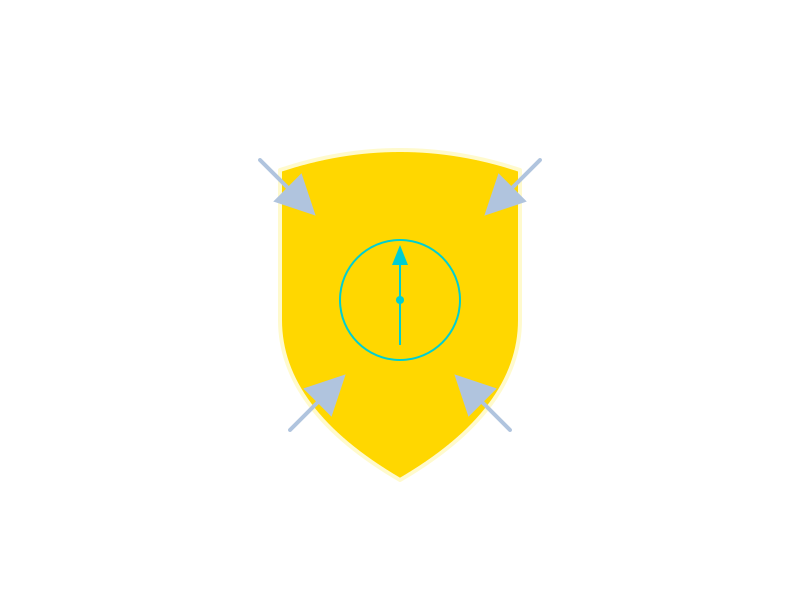
If I could impart one truth about self-awareness, it’s that it operates as a personalized fortress against the unending siege of external expectations. Self-awareness is fundamentally about understanding who you actually are, an identity that often clashes violently with the person your parents, mentors, or social media timelines wish you to be 1. The moment you internalize this distinction, the destructive power of societal pressure drops to zero; you become impenetrable. Consider the pragmatic genius of Vaynerchuk’s early life: he was told by his teachers that he was going to be a loser because of his terrible grades, yet he never let that judgment penetrate his dome 1.
Why? Because he knew his truth. He didn’t just like money; he loved the game of building a business—selling lemonade, shoveling snow, trading baseball cards—and that internal pull was stronger than any external grade card or peer approval. The ability to prioritize your intrinsic love (like trading cards) over what’s currently deemed “cool” is the ultimate measure of having a well-developed internal compass.
This internal clarity also saves you from the pitfalls of endless, unproductive introspection—what Mark Manson touches on when discussing the trap of over-pathologizing the normal. We often confuse self-awareness with inventing complex, emotionally satisfying narratives.
We might spend years in therapy constructing a memory of a protective mother warning us against strangers to explain why we struggle to make friends today, when the simpler, more uncomfortable truth might just be that we are intrinsically introverted, or we just haven’t found the right environment yet 2. Genuine self-awareness is practical; it sees the kid who loves the hustle, not the failing student.
Aligning Self-Awareness with Happiness and Joy
Self-awareness isn’t just about escaping traps; it’s the engine for authentic joy. The greatest barrier between most people and profound happiness is not a lack of opportunity, especially in this information-rich era, but sheer, paralyzing insecurity. We hesitate to start that Instagram account, put out that content, or even talk about our esoteric interests because we are terrifyingly worried about the number of likes, the negative comments, or, worst of all, what the person sitting right next to us thinks. We must realize that alignment is happiness’s primary lever.
It sounds cliché, but when you spend your days doing what you love, even if it’s something nobody else understands—like loving kites or dedicating yourself to reading when your peers only talk about brands—you gain an immediate, undeniable competitive edge: emotional fulfillment. It is easy to love what everyone else loves, like the latest sneaker drop or the star athlete; the difficult, defining task is loving what is uniquely, authentically you 1. The simple, actionable takeaway is this: the greatest gift of self-awareness is the courage to communicate who you are to the world.
We are living in an unprecedented era of opportunity, a massive blessing that allows us to find and build niche communities around any interest imaginable. The moment you figure out how to stop factoring in other people’s opinions and instead start putting your genuine interests out there—even if they seem weird or uncool—is the very moment you start getting real happy, real fast.
The Mechanism: How Self-Awareness Gives You Control
Use Schopenhauer’s Subject/Object Split
The true mechanism by which self-awareness grants us control isn’t magic; it’s a philosophical jujitsu move that re-engineers consciousness. We spend most of our lives operating from an unexamined default setting, where our feelings and impulses are so intertwined with our core identity that they simply are us. As long as this remains true, we are not driving the car; the emotional bundle known as the ego is . This is where Arthur Schopenhauer gives us the blueprint for liberation, arguing that consciousness must always contain two divisions: the Subject (the conscious observer) and the Object (whatever is being observed).
In our typical, knee-jerk state, we are the Subject, and our rage, anxiety, or deep-seated insecurity remains bundled within that intangible “I.” Because it is not separate, it cannot be analyzed; it can only be felt and reacted to. Self-awareness demands that we intentionally shift that dynamic. It means forcing our own thoughts and feelings to become the Object of consciousness.
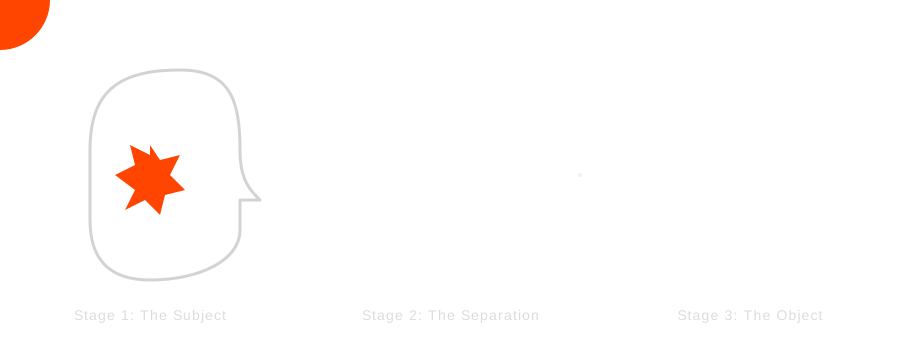
When you observe your anger, it immediately separates itself from the core Subject—the “me”—and suddenly you can regard it as an external phenomenon. You create mental space. Once separated, this objectified feeling can be held up to the light and assessed:
- Why does it exist?
- Is it legitimate?
- Should I even care? This separation is not abstract; it’s the definitive tool for chipping away at the ego and establishing sovereignty over your own mind.
Convert Emotions into Actionable Data
If the Subject/Object flip is the philosophy, then the result is utterly pragmatic: we turn emotional volatility into usable, quantitative data. When feelings and impulses are undifferentiated from the self, they hold control. They manifest as automatic behaviors—snapping at a loved one, procrastination born of fear, or financial recklessness rooted in insecurity. The moment self-awareness is applied, these feelings lose their command structure.
This is why self-awareness is the non-negotiable prerequisite for handling any serious emotional baggage that has held us back for decades. If you are unaware of your deep-seated biases or the transient, flickering nature of your frustration, you will accept them as eternal, legitimate truths. You will remain trapped by the “I” that constantly gets in its own way. Only by making the anger the object of analysis can you recognize that it is merely passing, a momentary weather system rather than an unchangeable climate.
Practices like journaling and meditation are nothing more than formalized training regimens for Schopenhauer’s division. Journaling forces you to write down the chaotic Subjective “I” so you can observe it objectively on paper. Meditation teaches you to watch thoughts and feelings drift past as though they are separate entities, enabling you to dis-identify with them.
When we apply this discipline, the chaos of the psyche transforms into a series of data points. And once you have data, you have the ability to make rational, strategic decisions, moving from the emotional reaction of “I am failing” to the analytical stance of “I am observing failure, let’s see what caused it.” That switch is the difference between an accidental life and a controlled destiny.
The Paradox: When ‘Knowing Thyself’ Becomes Destructive
Self-Awareness: More Like Medicine Than Money
After realizing the foundational power of self-awareness—how it shields us from external noise and allows us to objectify our inner life—we must now confront its insidious limit. For decades, the self-help industrial complex has convinced us that self-awareness is like money: if you have some, you should always strive for more. That’s a dangerous lie. Mark Manson rightly suggests that self-awareness is actually much more like medicine.
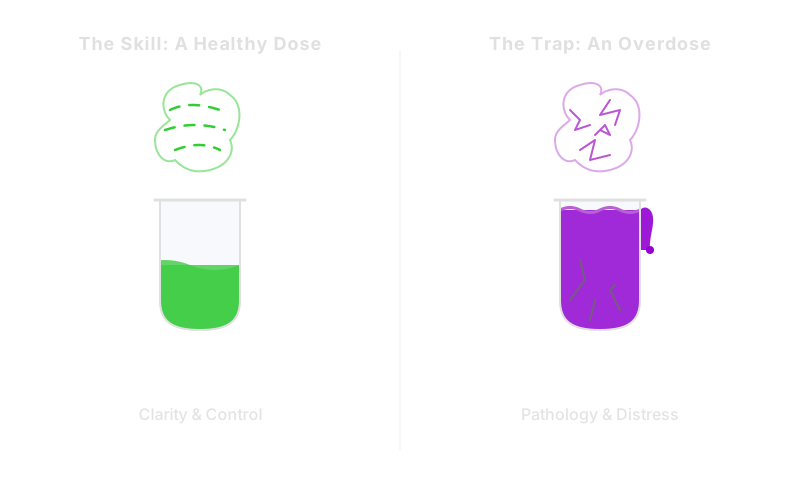
Think about it: if you are genuinely “sick”—lacking direction, paralyzed by external expectations, or controlled by unprocessed trauma—you desperately need a dose of introspective clarity. The Subject/Object split is the cure. But if you’re already reasonably healthy, functional, and your life is stable, consuming ever-increasing doses of self-analysis can actively make you sick.
We are currently seeing a terrifying social trend where awareness of mental health issues is at an all-time high, yet actual mental health appears to be at an all-time low. The signal is simple: the extra awareness isn’t helping; it’s harming. We have crossed a subtle, perilous line.
Avoid Pathologizing Normal Discomfort
The core danger of excess self-awareness is that it morphs from genuine insight into pathologizing the normal. Instead of recognizing normal human discomforts—transient anxiety, mild sadness, or fleeting anger—as simple feedback, we are conditioned to view them as deep-seated psychological problems that must be solved, unpacked, and rooted out. The self-help dogma has convinced us that every minor emotional ripple is a repressed childhood trauma demanding an expensive excavation. This is why Manson’s critical advice is so essential: don’t fix what isn’t broken.
If your life is generally functioning, if you have relationships and stability, the urge to keep digging for new flaws is self-sabotage. Anxiety, anger, and fear are not bugs; they are ancient, useful features designed to keep us alive and provide momentary guidance.
They are feedback—and sometimes, you simply don’t have to take the feedback. You can simply note the feeling and move on, rather than letting it spiral into a diagnostic crisis.
Beware: Self-Awareness Can Cause Self-Delusion
The worst manifestation of excessive introspection is the slide from self-awareness into self-delusion, which, frighteningly, feels exactly the same as genuine insight. When we enter a space, like therapy or intense journaling, without a clear, defined problem, our brains—in their desire to justify the effort—will naturally inflate a small, normal issue into a significant psychological hurdle. To validate this newly invented problem, the mind becomes an expert fiction writer, actively scouring vague memories to materialize a justification for the new feeling of loneliness.
This is not some fringe theory; it’s a documented phenomenon known as false memory syndrome, which, at its extreme, led to disastrous outcomes in the 70s and 80s when aggressive therapists incited fake memories in patients . The brain is remarkably adept at inventing narratives when the conscious mind feels it needs one. Healthy self-awareness seeks to normalize the pathological; unhealthy self-awareness, driven by the desire to perpetually “fix” the self, ends up pathologizing what’s normal, leaving us more anxious, not less.
Finding the Balance: Cultivating Healthy Self-Awareness
Stop Fixing Normal Discomfort
The critical difference between healthy, productive self-awareness (Vaynerchuk’s internal compass) and damaging, pathological self-obsession (Manson’s trap) lies in how we treat discomfort. The first rule for balance, then, is simple: stop viewing every negative emotion as a problem to be solved. Anxiety is a natural evolutionary response.
- Anger can be a useful signal that a boundary has been crossed.
- Fear keeps you from walking off a cliff. These are not malfunctions demanding expensive psychoanalysis; they are simple, biological feedback mechanisms 2. We have been wrongly taught to pathologize the normal.
If your life is generally stable, don’t look for internal problems; don’t inflate small discomforts into major psychological hurdles just because the self-help industry insists that constant self-improvement is necessary. The obsession with identifying and eradicating every imperfection just increases mental health distress, proving the medicine is making the healthy patient ill.
The moment you accept that natural emotional volatility is a part of being human, and not a flaw in need of repair, you drastically reduce the internal pressure to perform. Sometimes, you need to acknowledge the feedback and then just let the feeling go.
Journaling: Reflect, Don’t Obsess
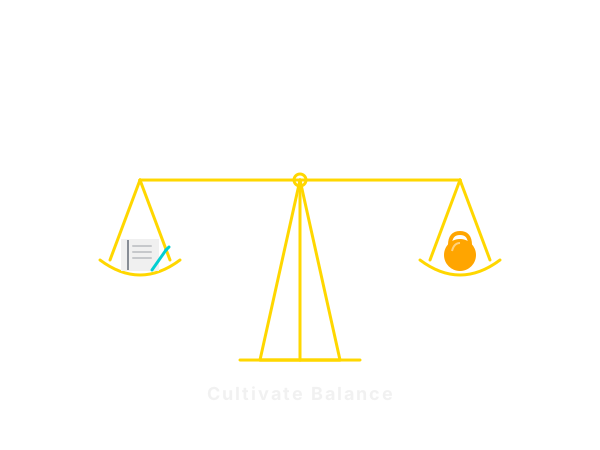
To maintain this delicate balance, we need tools that encourage periodic reflection without demanding perpetual obsession. This is where simple practices, like journaling, outperform endless, aimless therapy. When we write down our subjective chaos, we perform the Schopenhauerian Subject/Object separation ourselves, creating a non-judgmental space to analyze. Journaling achieves what therapy often tries to do—allowing us to express feelings and then consider them rationally—but offers a superior advantage: a historical record.
I can look back at past entries and see how clueless I was or how intensely I worried about something that vanished a week later. This historical perspective, as supported by software like Day One , proves the transient nature of emotional objects. This proves the transient nature.
It reminds you that the intense anger you felt last Tuesday is gone, confirming that your feelings are not permanent aspects of the Subject, but passing weather. Use these tools to check in, fix what truly is broken, and then close the book and live your life.
Use Exercise to Escape Introspection
Perhaps the most potent antidote to over-awareness is physical activity. If your mind is running in self-conscious loops, the best thing you can do is occupy the body. An overactive, introspective mind is effectively quelled by a busy body 2. Whether it’s hitting the gym, going for a run, or even just aggressively cleaning the house, physical movement diverts mental energy away from endless rumination.
It grounds you. This isn’t about deep psychoanalysis; it’s about practical neurobiology. When you are focused on the strain of a heavy lift or the rhythm of your breathing, you simply do not have the cognitive resources left to invent vague maternal warnings or inflate minor insecurities.
Physical activity forces the Subject to focus on the external Object of the moment—the motion, the muscle, the task—thereby preventing the Subject from turning inward and consuming itself. Ultimately, healthy self-awareness requires recognizing what truly is you (your genuine loves and ambitions, like Vaynerchuk’s hustle) and refusing to spend precious bandwidth dissecting the feelings that are merely passing through.
Conclusion
Navigating the complexities of self-awareness, we’ve journeyed from its vital role as a compass for our endeavors to the precipice where introspection can become a trap. Gary Vaynerchuk’s entrepreneurial spirit highlights its power in forging an authentic path. Mark Manson, meanwhile, warns us against the modern tendency to over-analyze, to mistake normal human discomforts for profound pathologies.
We’ve seen how the Subject/Object split, as articulated by Schopenhauer, offers a powerful mechanism to dissect our emotions, transforming them into manageable data rather than overwhelming forces. Yet, like any potent medicine, too much self-awareness can indeed make us sick, leading us down the dangerous path of pathologizing the normal and even creating false memories to justify our anxieties.
So, where does this leave us? The goal isn’t to cease introspection entirely, but to practice it with intention and balance. It’s about recognizing when discomfort is a signal to heed and when it’s just passing weather. It’s about using tools like journaling and physical activity not to obsess over every inner tremor, but to gain perspective and ground ourselves.
Ultimately, the true mastery of self-awareness lies not in knowing every single detail about yourself, but in knowing enough to live authentically and joyfully. It’s about understanding what truly drives you, like Vaynerchuk’s innate love for the hustle, and using that knowledge to build a life aligned with your core values, rather than getting lost in the echoes of self-doubt. Remember, self-awareness is your tool, not your master.


