


Stop reading those Five Productivity Hacks of the Gods articles immediately. Seriously, put the phone down. Stop reading immediately.
I spent years addicted to self-help literature, reading about optimization while my actual procrastination rate soared through the roof—a situation so embarrassing I almost preferred the dark web. The hard truth, articulated brilliantly by Mark Adams, is that we aren’t one self; we are perpetually at war.
We are locked in a civil war between the Critical Self, who plans the life we want, and the Experienced Self, that myopic hedonist demanding immediate pleasure. This isn’t a minor scheduling error; it is a distributional issue of justice.
If you’re still relying on vague goals and sheer willpower, you are fighting a knife fight with a butter knife. Willpower fails because it is a finite resource the hedonist will always outspend. The only way out of this trap is to stop asking your worst self to cooperate and start building mechanisms so that non-compliance is instantly, massively consequential.
Why Willpower Fails: The Civil War Inside Your Head
Critical Self vs Experienced Self: The Internal War
We often operate under the delusion that we are a single, rational being—the classic Homo economicus model beloved by early economics—but Mark Adams correctly points out that this belief system is fundamentally broken 1. In reality, we are perpetually locked in a civil war between two distinct entities: the Critical Self.
The Critical Self is the strategist, the future-oriented architect who meticulously plans that workout, schedules the difficult conversation, or realizes you must not go out the night before a major presentation. Contrastingly, the Experienced Self is entirely myopic, living solely to maximize pleasure in the present.
I’ve often felt this schism most acutely at 10 PM, when my Critical Self has already planned tomorrow’s 6 AM deep work session, and my Experienced Self convinces me that just one more episode of prestige television won’t hurt. The fundamental insight here is devastatingly simple: the person who makes the plan is demonstrably not the same continuous person who has to execute it .
Present Self Robs Future Self: Temporal Theft
This internal warfare isn’t just about scheduling conflicts; it’s a deep, structural moral failing toward your future identity. Adams frames this beautifully in legal and economic terms as a “distributional issue of justice over time.” What does that mean in practice? It means that when your Experienced Self maximizes its enjoyment right now—whether through excessive screen time, a financial splurge, or postponing crucial tasks—it is actively stealing resources and opportunities from the version of you that will exist tomorrow .

Think of the legendary footballer George Best, whose life exemplified this conflict: the Experienced Self indulged wildly, while the Critical Self (and his health) ultimately paid the price. Every time we procrastinate or indulge, we are creating a severe deficit for our future.
We are essentially forcing the future version of us to take on debt—not just financial, but emotional, time, and health debt—because we maximized comfort in the present. The Experienced Self is a narcissistic thief, taking everything it can and leaving the consequences for its successor; and that successor is you.
Why Willpower and Affirmations Always Fail
The billion-dollar self-help industry thrives on the fiction of continuous selfhood. They sell us on the idea that willpower is the only muscle we need. We sit down on January 1st, feeling the powerful, optimistic glow of the Critical Self, and write down expansive goals, believing that sheer mental fortitude will carry us through the year. We try the affirmations, the cold showers, and the “five productivity hacks of Elon Musk” we found on LinkedIn, adopting a fleeting, superficial “hacker mentality” .
I know this game intimately. I spent years in a fog of “success literature” addiction, reading everything there was to read, only to find my actual procrastination levels soaring; I knew what I should do, but the doing never materialized. Willpower fails precisely because it is a finite resource that is entirely dependent on the Critical Self winning a daily battle against the Experienced Self.
Affirmations and vague self-talk are like whispering soft encouragements to a mutinous army; they assume cooperation where only deep, structural conflict exists. True productivity, and the genius of the Lock-In system, is not about trying to motivate the two selves to cooperate; it’s about strategically caging the Experienced Self so that cooperation is rendered irrelevant.
The Urgency: Why We Need a Human Upgrade in the Age of AI
Technology Outpaces Human Adaptability: The Urgency
The internal conflict between the Critical Self and the Experienced Self is not new—it’s been grinding us down since the dawn of civilization. But what is new, what gives this old psychological battle profound urgency, is the terrifying acceleration of the external world. Thanks to Moore’s Law and the resulting exponential growth of technology, our environment is changing at a rate our prehistoric brains simply cannot process. Adams notes that this rapid, nearly “exothermic reaction” of change means human adaptability is failing to keep pace .
I believe this is the central anxiety of our age: the world demands radical, rapid personal reinvention, yet we are internally optimized for inertia. Think about it—Adams’ work involves meeting with leaders, CEOs, and government figures, and the core mandate is always the same: “Please change this person who just does not want to change” . If the most powerful, resourced people in the world can’t compel themselves to adapt at the necessary speed, what hope is there for the rest of us fighting off our experienced self’s demand for another dopamine hit? I believe this is the central anxiety of our age: the world demands radical, rapid personal reinvention, yet we are internally optimized for inertia.
The reality is that we are at a pivotal moment in history where our ability to evolve is lagging behind the evolution of our tools. The rate of change isn’t merely fast; it’s accelerating faster and faster and faster.
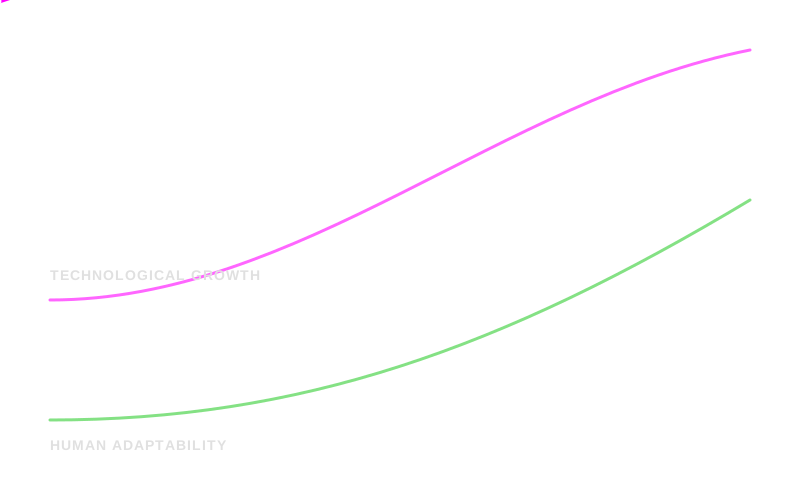
This isn’t just an existential problem for the figurative “Mr. Burns’s and the CEOs of the world”; it impacts every single business and, crucially, every single human being . If we continue to rely on obsolete mechanisms like mere willpower, the future arrives faster than we anticipate—will simply leave us drowning in obsolescence.
Shift From Goals to Irreversible Action
The crisis we face is not a lack of information; it’s an execution deficit. We’re aware of the technological demands, and we know our jobs might not exist in 15 years—after all, Adams himself does a job that wasn’t even listed by career counselors when he was in school . The critical failure point is the inability to translate that future knowledge (Critical Self) into immediate action (Experienced Self). The old human operating system, based on hope, goals, and vague resolutions, cannot handle the bandwidth required by the 21st century.
We need an immediate system upgrade. The traditional January 1st method—sitting down, getting rid of the metaphorical ‘cone,’ and drafting a list of ambitious goals—is a delightful fantasy that caters only to the short-lived optimism of the Critical Self . This method fails because it attempts to use a soft, motivational lever (willpower) to defeat a primal, deeply entrenched opposition (immediate gratification). You cannot fight fire with a damp suggestion.
This is where the radical, necessary genius of the Lock-In system emerges. It rejects the polite self-help dialogue and instead embraces the terrifying truth: the only way to achieve exponential success in an exponential world is by making irreversible decisions. We must bin the useless affirmations and goals.
Instead, we contract with ourselves in a way that is painful, primal, and unavoidable. The Lock-In system is, fundamentally, an operating system update that harnesses our deepest evolutionary instinct—the powerful drive to avoid pain and brutal consequences—and weaponizes it for maximum, radical speed.
The ‘Lock-In’ Solution: Harnessing Fear for Extreme Productivity
Make Failure Your Fuel: Embrace Fear
The intellectual argument against procrastination is compelling, but the emotional cost is what ultimately breaks us. Adams shares a deeply personal anecdote that crystallized his need for the Lock-In system: the failure to record a simple mixtape for his ailing grandmother. He and his brother procrastinated, promising their future selves would handle it, until one day the call came—Nana was gone. “Don’t worry about the tape,” his mother said .
This wasn’t a failure of willpower; it was a devastating moral failure caused by temporal theft. They were caught in the immediate moment—the Experienced Self reigned supreme—and the Critical Self, which knew exactly what needed to be done for the person they loved, perpetually delayed action. The Experienced Self reigned supreme.
The terrible consequence of this inaction became the final straw, forcing them to confront the crippling anxiety and procrastination that had defined 95% of their lives. That mixtape failure wasn’t just about a grandmother’s unfulfilled wish; it was proof that the ‘future self’ never arrives to pick up the slack. The final straw forced confrontation.
From Promises to Contracts: External Enforcement

The fundamental difference between a goal and a Lock-In is the difference between a promise and a legally enforceable contract. Our entire commercial world runs on contracts precisely because they are legally enforceable and carry penalties for non-compliance. Yet, when we make promises to ourselves—to wake up early, to write that chapter, to save that money—they come with zero enforceability. Promises without the sword are nothing but words.
The Lock-In system demands that you stop making promises to yourself and start signing binding contracts. The aim is to change the payoff matrix using game theory: you must make the cost of not doing the work significantly more expensive and painful than the effort of doing it .
This is not just theoretical; Adams and his brother started exploring how they could enforce each other’s commitments, turning a vague internal resolution into a mutually assured destruction scenario. This external enforcement is the ultimate strategy for caging the myopic Experienced Self and ensuring the Critical Self’s plans are realized.
The Cortés Strategy: Burning Your Ships
The core mechanism of Lock-In is making fear your friend. This isn’t touchy-feely motivation; this is primal, evolutionary psychology at work. We are wired to avoid pain more strongly than we are wired to seek abstract rewards. If you make the consequence of failure genuinely painful and massively consequential, you render the experienced self’s short-term desires irrelevant .
Think of Cortés arriving in South America and immediately burning his ships. By eliminating the option of retreat, he made failure—death or destruction—more terrifying than the daunting task of conquest. This is the mindset.
Adams points to modern, albeit softer, examples like self-excluding from casinos—literally creating a structural barrier against the Experienced Self’s impulse. The Lock-In system is designed to trigger an “exorcism” within you; the Experienced Self will fight back, kicking and screaming, but when the path to retreat is incinerated, it must eventually submit to the inevitability of the Critical Self’s plan 1.
If you can strategically invert your psychological drivers—making failure more terrifying than success is exhilarating—you unleash an insane, radical speed of achievement. This approach is not for the faint of heart, but if we are to update our human operating systems fast enough to keep pace, embracing this level of irreversible commitment is the only viable path forward.
Historical Blueprints for Irreversible Commitment
Ulysses and the Sirens: The Original Lock-In
To understand the genius of the Lock-In system, we must look backward, far beyond the Silicon Valley gurus, to the ancient blueprints of forced compliance. The mythological tale of Ulysses (Odysseus) and the Sirens is the quintessential example of a pre-commitment strategy. Ulysses knew his Critical Self understood the deadly peril of the Sirens’ song, but he also knew his Experienced Self—that “werewolf self” that craves maximum pleasure in the present—would take over once the seductive music began .
His solution wasn’t meditation or affirmations; it was binding, irreversible structural constraint. He had his men tie him tightly to the mast and ordered them to ignore all his future pleas and commands.
By taking this drastic action before the temptation arrived, Ulysses’ Critical Self successfully locked in his future behavior. This narrative perfectly illustrates how we can proactively disarm our short-term, maximizing impulse by physically or structurally constraining our own freedom when we are in a moment of clear rationality.
Cortés’s Strategy: Eliminating Retreat
If Ulysses offers the intellectual example of self-constraint, Hernán Cortés provides the brutal, military-grade model. When Cortés arrived in Veracruz in 1519, he ordered his men to burn the ships, leaving absolutely no means of retreat back to Cuba. The message was clear, primal, and deeply terrifying: succeed in the conquest, or die. There was no going back.
This is the origin of the core philosophy of the Lock-In system: you must make failure—the alternative—so utterly impossible or devastating that your only rational choice is forward. Cortés made fear his army’s friend.
Our modern equivalents might be less dramatic than incineration, but the psychology remains the same: self-excluding from a vice (like the modern example of banning oneself from a casino) , or creating a system where non-performance results in massive financial or public consequence. The Lock-In is a psychological firewall; when the Experienced Self inevitably tries to control you, it finds the exit ramp has been demolished.
Game Theory: Rewriting the Payoff Matrix
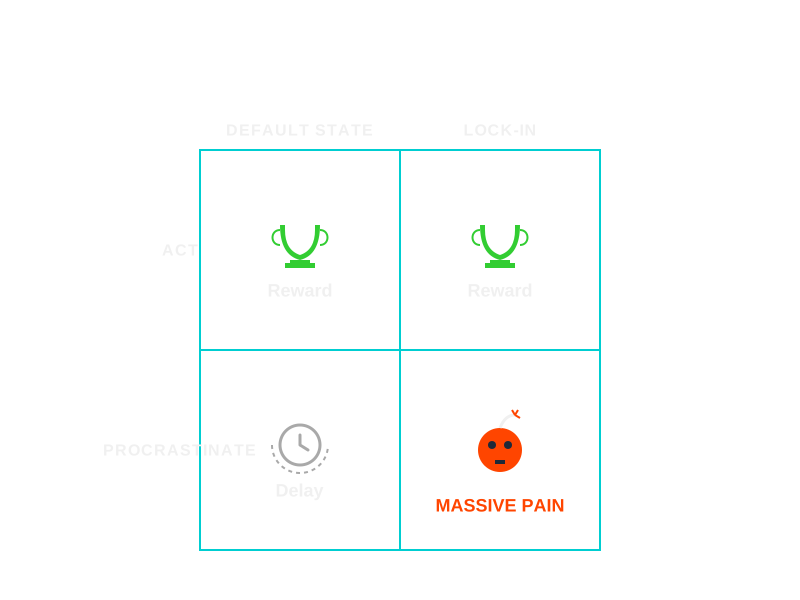
The beauty of the Lock-In system is that it moves beyond psychology and into the hard realm of strategy, specifically game theory. Adams emphasizes that this is fundamentally about mutual assured destruction—or at least self-assured destruction—by “changing the payoff matrix” . When we consider a choice, we weigh the potential benefit (say, temporary pleasure) against the potential cost (delayed task). The Experienced Self always chooses the path of least resistance because the consequences of failure (the distributional issue of justice) are abstract and distant.
To truly lock in, the Critical Self must engineer the environment such that choosing the unproductive option becomes really expensive, really painful, and massively consequential. For instance, if you contract to pay a massive fine to a charity you despise if you miss a deadline, the immediate pain of that financial loss instantly outweighs the fleeting pleasure of procrastination.
The key insight is that our human operating system defaults to maximizing the present, but the Lock-In system weaponizes a deeper, more powerful instinct—the avoidance of immediate, brutal pain—to achieve exponential results. This update moves us from wishful thinking to guaranteed execution.
Conclusion
We’ve journeyed through the internal battlefield of our minds, recognizing the persistent war between our long-term aspirations (the Critical Self) and our immediate desires (the Experienced Self). Traditional methods, relying on willpower or vague affirmations, often fail because they ask warring factions to coexist peacefully. It’s like asking a wolf to guard the sheep!
The rapid pace of technological change demands a more robust solution, one that acknowledges the fundamental disconnect between who we plan to be and who we actually are in the moment of decision. This is where the “Lock-In” system, with its historical echoes from Ulysses to Cortés, offers a radical paradigm shift. It’s not about self-improvement; it’s about self-enforcement through irreversible commitments.
By strategically making failure agonizingly costly and success the only viable (albeit perhaps daunting) path, we bypass the unreliable levers of motivation. We build the ship and burn the bridges behind us, not out of cruelty, but out of a profound understanding of our own nature. It’s about updating our human operating system to match the relentless acceleration of the external world.
Ultimately, the “cult of extreme productivity” isn’t about chasing fleeting dopamine hits, but about architecting a future where your best intentions are backed by unavoidable consequences. It’s about recognizing that the best way to control your future self is to bind your present self with chains forged from foresight and a healthy respect for pain. The greatest productivity hack, it turns out, is to make quitting the most painful option available.


